
NEWS > Technical Knowledge Hub > What Is an Upfitter? Integrating LinkChamp Power Solutions into Purpose-Built Vehicles
What Is an Upfitter? Integrating LinkChamp Power Solutions into Purpose-Built Vehicles
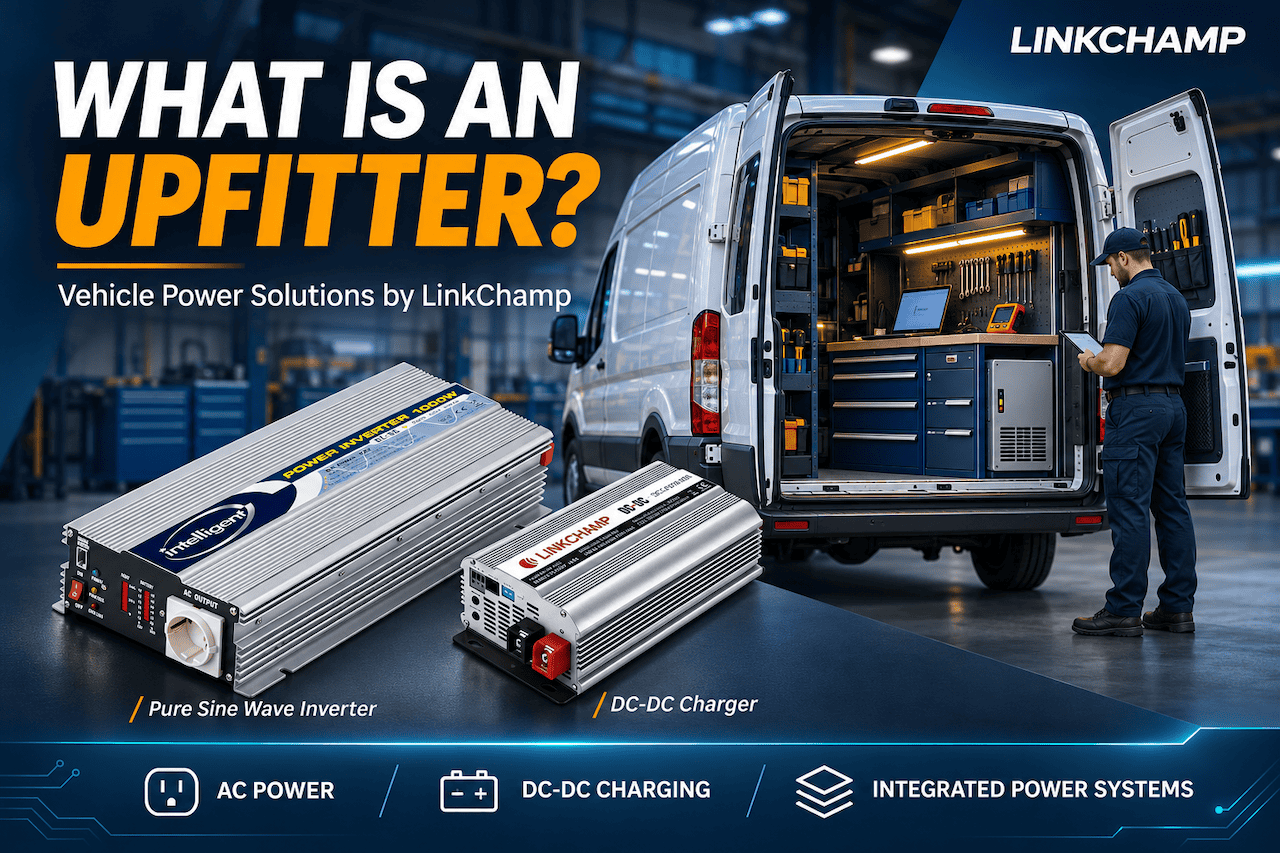
What Is an Upfitter? Integrating LinkChamp Power Solutions into Purpose-Built Vehicles
A service van may need to power diagnostic equipment at a customer's site. A mobile office may require AC electricity for computers and printers. A camper van may need battery power, external AC charging, and solar charging in one compact installation.
Turning these requirements into a practical vehicle is the work of an upfitter. Alongside storage, equipment mounting, and interior layout, onboard electrical power is an important part of many vehicle upfitting projects.
As a professional Taiwan inverter manufacturer, LinkChamp provides pure sine wave inverters, DC-DC chargers, inverter chargers, and hybrid inverters that upfitters can integrate into mobile power systems.
What Is an Upfitter?
An upfitter is a specialist business that equips or modifies a vehicle for a particular job. In commercial applications, this often means turning a truck or van into a service vehicle or mobile workspace.
Upfitting describes the modification and integration work; the upfitter is the company performing it. Depending on the project, the work may include storage systems, equipment mounting, and onboard electrical installations.
For electrically equipped vehicles, the upfitter brings the vehicle, batteries, power conversion products, and connected equipment together into a working system. LinkChamp supplies power conversion and charging products for this integration.
Why Onboard Power Matters in Vehicle Upfitting
Vehicle batteries supply direct current (DC), while many workplace appliances require alternating current (AC). An onboard power system connects these different electrical needs and provides a way to replenish the energy used during the day.
Common requirements include:
- AC power for laptops, printers, diagnostic instruments, and tool battery chargers
- auxiliary battery charging while driving
- battery-powered operation while parked
- external AC power and charging when the vehicle returns to a base
- solar charging for suitable mobile applications
The design starts with what equipment will run, for how long, and when charging will be available. These answers determine the battery capacity and power conversion functions required.
How LinkChamp Products Support Upfitting Projects
SN Series: AC Power from an Auxiliary Battery
LinkChamp's SN Series pure sine wave inverters convert battery DC power into AC electricity for connected equipment.
For a service van or mobile workspace, an upfitter can pair an SN Series inverter with an appropriately sized auxiliary battery to power equipment away from external AC outlets. Pure sine wave output is useful for equipment that requires a high-quality AC waveform.
The inverter must match the equipment's continuous power and startup demands. The battery and charging system determine how long that equipment can operate.
DCC Series: Auxiliary Battery Charging While Driving
The DCC Series DC-DC chargers provide controlled charging from a vehicle's DC electrical system to an auxiliary battery. They support conventional and smart alternators, with battery profiles selected to suit the installed battery.
For 12V-to-12V charging, options include the DCC1212-30A and DCC1212-60A. Charging current selection depends on alternator capacity, battery charging limits, and available driving time.
A practical combination is DCC Series charging plus an SN Series inverter: the DCC charger replenishes the auxiliary battery while driving, and the inverter supplies AC power from that battery when needed.
SN-T Series: Inverter Power with Automatic AC Transfer
The SN-T Series combines a pure sine wave inverter with an automatic transfer switch (ATS) and AC bypass functionality.
This suits vehicles that use external AC power when available and battery inverter power elsewhere. The integrated transfer function switches the AC supply between these sources.
Battery charging is provided separately in this configuration. For equipment that must remain running during transfer, the upfitter should check the selected model's transfer time against the equipment's requirements.
SN-C Series: Inverter, AC Bypass, and Battery Charging
The SN-C Series inverter chargers combine pure sine wave inversion, AC bypass, and battery charging from an external AC source.
For vehicles that return to a depot or workshop, this configuration allows compatible external AC power to supply loads through bypass and recharge the auxiliary battery. Away from the base, the inverter provides AC electricity from stored battery energy.
Where charging while driving is also required, a suitable DCC Series charger can be included in the system, with charging settings coordinated for the shared battery.
SN-H Series: Integrated Power Conversion and Solar Charging
The SN-H Series 4-in-1 hybrid inverters integrate four functions:
- pure sine wave inversion
- automatic AC transfer and bypass
- battery charging from external AC power
- solar charging
For camper conversions or mobile work vehicles with suitable solar panels, this design brings several power functions into one unit. A separate DC-DC charger can provide vehicle-based charging where required.
The solar array must match the selected model's PV input specifications. Solar contribution depends on panel capacity, sunlight, and installation conditions.
Matching Products to Vehicle Power Requirements
Upfitters can select a modular or integrated approach according to the functions needed.
| Vehicle Power Requirement | LinkChamp Configuration to Consider |
|---|---|
| AC power from a battery | SN Series inverter |
| Charging while driving and battery-based AC power | DCC Series charger plus SN Series inverter |
| External AC bypass and automatic transfer, with charging handled separately | SN-T Series |
| External AC bypass, AC battery charging, and inverter power | SN-C Series; add a DCC charger if vehicle-based charging is needed |
| Inverter power, AC transfer, AC charging, and solar charging | SN-H Series; add a DCC charger if vehicle-based charging is needed |
These are alternative system configurations. The choice depends on the vehicle's power sources, equipment loads, and installation space.
Example: A Working Day for a Mobile Service Van
Consider a van carrying a laptop, diagnostic instruments, and cordless tool battery chargers. An upfitter could build its power system around an auxiliary battery, a DCC Series charger, and an SN-C Series inverter charger.
| Operating Situation | Charging and Power Supply |
|---|---|
| Driving between jobs | The DCC charger uses available vehicle DC power to charge the auxiliary battery |
| Parked at a customer's site without external AC power | The SN-C inverter supplies AC equipment from the auxiliary battery |
| Connected to compatible external AC power | The SN-C provides AC bypass and battery charging |
| Returning to the depot | External AC charging replenishes the battery for the next working day |
This arrangement provides charging opportunities during travel and at the base. Operating time still depends on usable battery energy and actual equipment consumption.
Key Considerations When Selecting a Vehicle Power System
Selecting an inverter by wattage alone does not define a complete onboard power system. Upfitters should assess the following together:
| Factor | What to Check |
|---|---|
| AC equipment | Continuous loads, simultaneous use, and startup surge |
| Battery system | Voltage, usable capacity, chemistry, and discharge limits |
| Charging sources | Alternator capacity, driving time, external AC access, and solar availability |
| Charger settings | Battery manufacturer's requirements and combined charging current where multiple chargers are installed |
| AC output | Voltage, frequency, socket type, and transfer-time requirements |
| Installation | Space, mounting, ventilation, temperature, and service access |
| Electrical integration | Cable sizing, circuit protection, grounding, and vehicle manufacturer requirements |
For example, increasing inverter output does not automatically extend runtime. Longer operation may require more usable battery capacity, more charging opportunities, or lower average consumption.
Working with LinkChamp on OEM and Project Requirements
Upfitters often need a power configuration that can be repeated across a fleet while fitting a particular vehicle platform.
LinkChamp provides OEM/ODM support for power conversion and charging applications. For DCC Series projects, charging and protection parameters can be discussed, including low-voltage thresholds, restart thresholds, and input-voltage-based charging current reduction. Availability depends on the selected model and agreed project specifications.
Sharing the vehicle's electrical specifications, battery details, equipment loads, operating schedule, and target market helps LinkChamp recommend suitable products and assess customization requirements.
Conclusion
A practical vehicle power system supports both the work performed on site and the charging opportunities available throughout the day.
From SN Series inverters and DCC Series DC-DC chargers to SN-T, SN-C, and SN-H integrated solutions, LinkChamp offers products that upfitters can combine according to the vehicle's operating needs.
Planning a mobile service vehicle, fleet installation, or camper conversion? Contact LinkChamp to discuss the power conversion and charging products for your project.
Explore LinkChamp power solutions or learn more about our company.