
NEWS > Technical Knowledge Hub > DC-DC Chargers Explained: How They Work and Why They Are Essential
DC-DC Chargers Explained: How They Work and Why They Are Essential
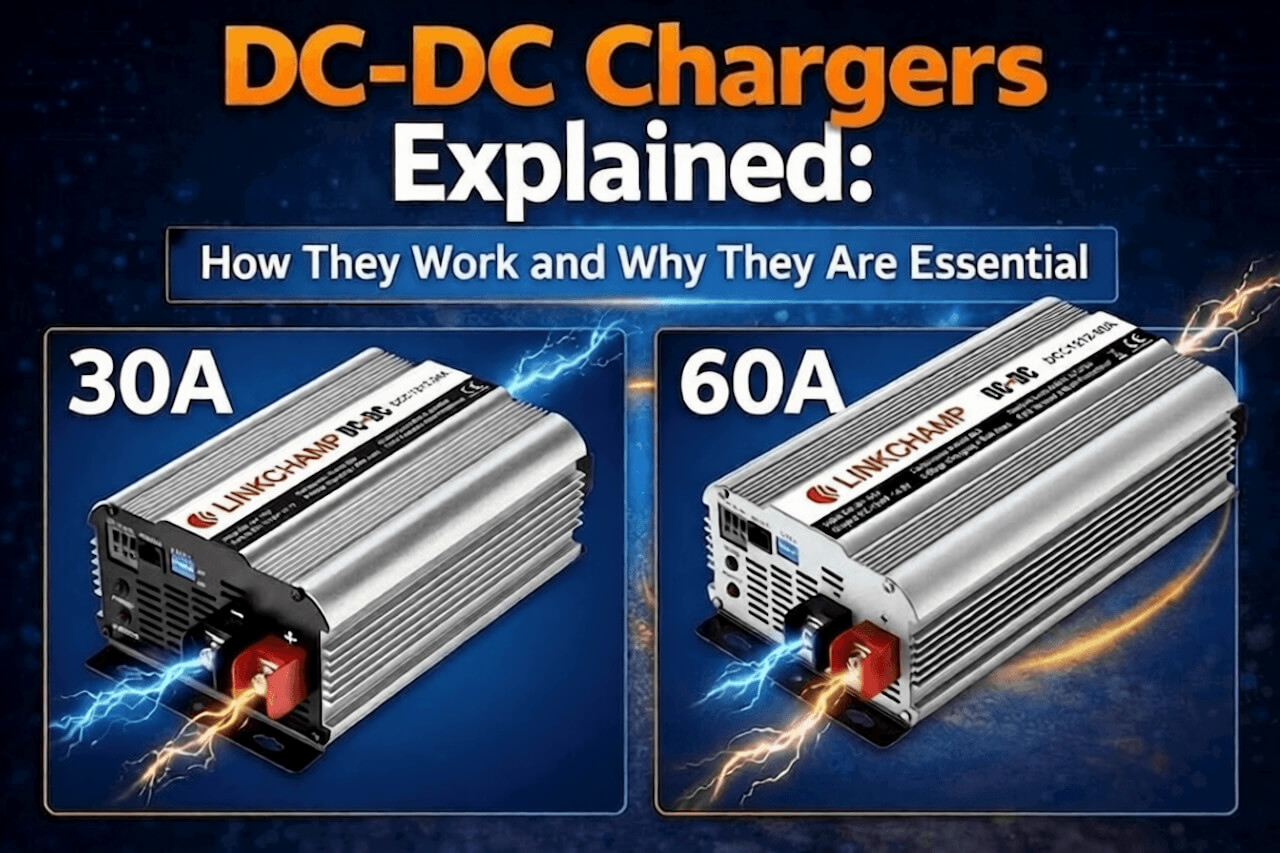
DC-DC Chargers – What They Are and Why They Are Essential for Modern Power Systems
DC-DC chargers are becoming increasingly important in modern electrical systems, especially in RV power systems, overlanding vehicles, marine installations, and service trucks. As battery technology evolves and lithium batteries become more common, traditional charging methods are often no longer sufficient.
A DC-DC charger regulates and optimizes the charging process between two DC power sources, ensuring that auxiliary batteries receive the correct voltage and current regardless of fluctuations in the primary power source.
As a professional Taiwan power electronics manufacturer, LinkChamp develops reliable charging solutions such as the DCC Series DC-DC Chargers to support demanding mobile and off-grid power applications.
What Is a DC-DC Charger?
A DC-DC charger is a power conversion device that takes DC power from a source and converts it into a controlled DC output suitable for charging batteries.
Unlike a simple voltage connection, a DC-DC charger performs regulated multi-stage charging, ensuring that the battery is charged safely and efficiently.
Typical power sources include:
- vehicle alternators
- starter batteries
- solar charge controllers
- DC power systems
The DC-DC charger then provides a stable and controlled charging output to the auxiliary battery.
Typical system configuration:
| Power Source | DC-DC Charger | Battery |
|---|---|---|
| Vehicle alternator | DC-DC charger | Auxiliary battery |
| Starter battery | DC-DC charger | House battery |
| Solar system | DC-DC charger | Battery bank |
Without proper regulation, batteries can be undercharged, overcharged, or damaged.
Why DC-DC Chargers Are Important
Modern vehicles and electrical systems often cannot directly charge auxiliary batteries effectively.
Several factors contribute to this issue:
- smart alternators that reduce voltage to save fuel
- voltage drop over long cable runs
- different battery chemistries
- lithium battery charging requirements
A DC-DC charger solves these problems by providing:
- stable charging voltage
- correct charging profile
- protection against overcharging
- optimized charging efficiency
For example, LinkChamp’s DCC Series DC-DC Chargers are designed to provide stable charging performance in mobile electrical systems.
How a DC-DC Charger Works
A DC-DC charger operates as a power converter combined with a smart battery charger.
The process generally includes several stages:
Input power regulation
The charger receives DC power from a source such as a vehicle alternator.Voltage conversion
Internal circuitry adjusts the voltage level to the proper charging voltage.Multi-stage charging control
Charging is regulated to match the battery’s optimal charging profile.
Typical charging stages include:
| Charging Stage | Purpose |
|---|---|
| Bulk charging | Rapidly charge the battery to most of its capacity |
| Absorption | Complete charging at controlled voltage |
| Float | Maintain battery charge without overcharging |
This charging process protects battery health and maximizes battery lifespan.
DC-DC Chargers vs Direct Alternator Charging
In many vehicle systems, auxiliary batteries are traditionally connected directly to the alternator through isolators or relays. However, this approach has several limitations.
| Feature | Direct Alternator Charging | DC-DC Charger |
|---|---|---|
| Voltage regulation | Limited | Precise control |
| Battery compatibility | Poor with lithium | Fully compatible |
| Charging efficiency | Low | High |
| Cable voltage drop compensation | No | Yes |
| Battery protection | Limited | Advanced protection |
Because of these advantages, DC-DC chargers are now widely used in modern mobile power systems.
Common Applications for DC-DC Chargers
DC-DC chargers are especially useful in systems where reliable charging from a DC source is required.
Typical applications include:
RV and Camper Van Electrical Systems
RV electrical systems often include:
- house batteries
- solar charging systems
- onboard inverters
- multiple DC loads
A DC-DC charger allows the vehicle alternator to safely charge the auxiliary battery while driving.
LinkChamp’s DCC1212-60A model provides high-current charging suitable for larger battery banks used in RV and overlanding vehicles.
Marine Power Systems
In marine environments, reliable battery charging is essential for systems such as:
- navigation electronics
- lighting
- refrigeration
- onboard power systems
A DC-DC charger ensures stable charging between engine batteries and service batteries while protecting sensitive electronics.
Overlanding and Off-Road Vehicles
Off-road and expedition vehicles often rely on auxiliary power systems for:
- portable refrigerators
- lighting systems
- communication equipment
- camping power systems
A DC-DC charger allows these systems to recharge while the vehicle is running.
The DCC1212-30A is a compact charging solution ideal for smaller battery setups.
Service and Utility Vehicles
Mobile work vehicles such as service trucks often power equipment including:
- power tools
- communication systems
- lighting equipment
- battery packs
A DC-DC charger provides a reliable charging solution for onboard battery systems.
Compatibility with Modern Battery Types
One of the main advantages of DC-DC chargers is their compatibility with different battery chemistries.
Supported battery types typically include:
| Battery Type | Compatibility |
|---|---|
| Lead-acid | Yes |
| AGM | Yes |
| Gel | Yes |
| Lithium (LiFePO4) | Yes |
Lithium batteries especially require controlled charging voltages, making DC-DC chargers essential for modern power systems.
Protection Features in DC-DC Chargers
High-quality DC-DC chargers include built-in protection mechanisms to ensure safe operation.
Typical protections include:
- over-voltage protection
- under-voltage protection
- reverse polarity protection
- over-temperature protection
- short circuit protection
These protections safeguard both the charger and the connected battery system.
Choosing the Right DC-DC Charger
When selecting a DC-DC charger, several factors should be considered:
| Factor | Consideration |
|---|---|
| Charging current | Match charger current to battery capacity |
| Input voltage | Ensure compatibility with vehicle electrical system |
| Battery type | Select proper charging profile |
| Installation environment | Consider temperature and ventilation |
| System expansion | Plan for future power needs |
For example:
- DCC1212-30A is suitable for smaller battery systems.
- DCC1212-60A provides higher charging capacity for larger power systems.
The complete product lineup can be found on the LinkChamp DCC Series page.
Why Choose LinkChamp DC-DC Chargers
LinkChamp DC-DC chargers made in Taiwan are designed for reliable operation in demanding environments such as RV electrical systems, marine installations, and mobile service vehicles.
In addition to standard protection features, LinkChamp also provides customizable charging and protection parameters to meet the specific requirements of different vehicle electrical systems.
For OEM and project-based applications, the following parameters can be customized upon request:
- Low voltage protection threshold to match different vehicle alternator characteristics
- Automatic restart voltage threshold to ensure stable charging recovery after protection events
- Adaptive charging current behavior, such as reducing charging current when input voltage drops below a defined level
For example, charging current can be configured to automatically reduce to 50% when the input voltage falls below 12V, helping prevent excessive load on the alternator or vehicle electrical system.
These customization capabilities allow our clients to optimize the DC-DC charger for their specific vehicle platforms, alternator designs, and battery systems, ensuring the best balance between charging performance, system stability, and long-term reliability.
As a professional OEM/ODM manufacturer, LinkChamp works closely with customers to deliver DC-DC charging solutions tailored to real-world applications.
Conclusion
DC-DC chargers play an essential role in modern electrical systems by providing safe, efficient, and controlled battery charging from DC power sources such as vehicle alternators or solar systems.
They are widely used in RV power systems, marine installations, service vehicles, and off-grid energy systems, where reliable auxiliary battery charging is required.
LinkChamp’s DCC Series DC-DC Chargers offer robust charging solutions designed for real-world mobile power applications. Models such as the DCC1212-30A and DCC1212-60A provide flexible charging options for a wide range of battery systems.