
NEWS > Technical Knowledge Hub > Inverter Charger Technology Explained
Inverter Charger Technology Explained
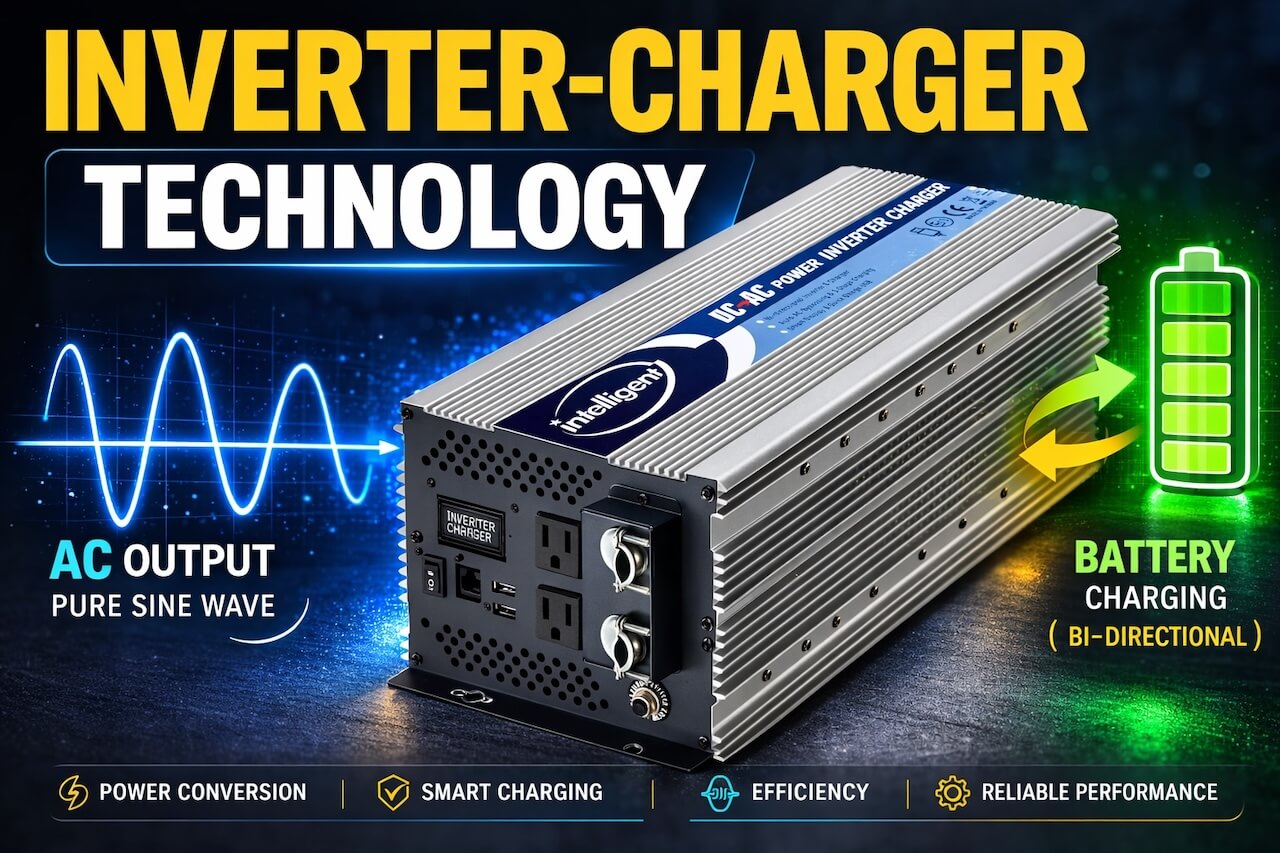
Inverter Charger Technology Explained
An inverter charger is an advanced power conversion device that integrates three essential components into a single system:
- DC-AC Power Inverter
- Multi-stage Battery Charger
- Automatic Transfer Switch (ATS)
By combining these functions, inverter chargers simplify electrical system design and improve overall reliability. These systems are widely used in applications such as recreational vehicles (RV), marine vessels, off-grid solar systems, residential backup power, and mobile service vehicles.
LinkChamp develops inverter charger solutions for many of these applications as a professional Taiwan inverter manufacturer.
How an Inverter Charger Works
An inverter charger manages the flow of energy between AC power sources, battery banks, and electrical loads.
The system typically operates in three primary modes:
| Operating Mode | Power Source | Function |
|---|---|---|
| Bypass Mode | Utility / Shore / Generator | AC power flows directly to loads |
| Charging Mode | Utility / Shore / Generator | Battery charger replenishes battery bank |
| Inverter Mode | Battery Bank | DC power converted to AC for loads |
Under normal conditions, incoming AC power from the utility grid, shore power, or a generator is passed directly to connected appliances through the AC bypass circuit. At the same time, the integrated battery charger converts AC power into DC power to charge the battery bank.
If external AC power becomes unavailable, the inverter charger automatically switches to inverter mode. The system begins converting stored battery energy into AC electricity, maintaining power to connected devices.
This automatic transition typically occurs within 20 milliseconds, allowing sensitive equipment such as computers, communication devices, and medical equipment to continue operating without interruption.
Learn more about LinkChamp's inverter charger solutions on our pure sine wave inverter charger page and modified sine wave inverter charger page.
Automatic Transfer Switch (ATS)
The built-in automatic transfer switch is one of the key features of an inverter charger system. Instead of requiring a separate external transfer switch, the inverter charger internally manages power source selection.
Typical transfer priorities may include:
| Priority Order | Power Source |
|---|---|
| 1 | Utility grid / Generator |
| 2 | Battery inverter |
When the primary power source fails, the system quickly transfers to the next available source. This capability is particularly important in:
• Residential backup systems
• RV power systems
LinkChamp also offers standalone Automatic Transfer Switch (ATS) with dual power sources (Priority 1 & 2).
Smart Multi-Stage Battery Charging
Efficient battery management is critical for long battery life and reliable system operation. Modern inverter chargers use multi-stage charging algorithms designed to optimize charging speed while preventing battery damage.
A typical 3-stage charging profile includes:
| Charging Stage | Purpose | Typical Battery State |
|---|---|---|
| Bulk Charge | Maximum current charging | 0–80% capacity |
| Absorption Charge | Controlled voltage charging | 80–100% capacity |
| Float Charge | Maintain full charge | 100% capacity |
Bulk Charging
During the bulk stage, the charger supplies the maximum available current to quickly replenish the battery bank. This phase typically restores up to 80% of battery capacity and is the fastest portion of the charging cycle.
Absorption Charging
Once the battery voltage reaches its target level, the charger transitions to the absorption phase. Charging current gradually decreases while voltage remains constant, allowing the battery to safely reach full capacity.
Float Charging
After the battery is fully charged, the charger enters float mode. A lower maintenance voltage is applied to keep the battery at full capacity without overcharging.
Proper charging stages significantly improve the lifespan of both lead-acid and LiFePO4 battery systems. LinkChamp also offers standalone Battery Chargers to integrate into the system if needed.
Real-World Applications of Inverter Chargers
Because inverter chargers integrate multiple power management functions into a single unit, they are widely used across many industries.
RV and Mobile Power Systems
In RV applications, inverter chargers allow travelers to operate AC appliances while maintaining battery charging whenever shore power or a generator is available.
Marine Electrical Systems
Marine environments require reliable power for onboard electronics, navigation equipment, and refrigeration systems. Inverter chargers allow vessels to operate AC equipment while managing battery charging from shore power when docked.
Residential Backup Power
Home backup systems use inverter chargers to maintain power during outages for critical household circuits such as refrigerators, lighting, internet routers, medical devices, and security systems.
Renewable Energy Systems
Off-grid solar systems commonly use inverter chargers as the central energy management device.
Advantages of Integrated Inverter Charger Systems
Compared with separate inverter and battery charger systems, inverter chargers provide several advantages.
| Benefit | Explanation |
|---|---|
| Simplified installation | Fewer devices and wiring |
| Automatic power switching | Seamless transfer during outages |
| Improved system efficiency | Optimized power management |
| Space saving design | Integrated architecture |
These benefits make LinkChamp's inverter chargers a preferred solution for modern mobile and backup power systems.
Conclusion
Inverter charger technology plays a vital role in modern power systems. By integrating a DC-AC inverter, intelligent battery charger, and automatic transfer switch, these systems provide reliable energy management for mobile, residential, and industrial applications.
As an experienced Taiwan inverter manufacturer, LinkChamp continues to develop high-quality power conversion solutions used worldwide.
Explore LinkChamp inverter charger solutions:
Inverter Charger Products
Learn more about our company:
About LinkChamp